
Power · Analysis
Nigeria Electrification Program

Milestones, Hurdles, and the Path Forward
In March 2024, Nigeria’s Minister of Power revealed that 92 million Nigerians lack access to the national grid—a number that would rank as Africa’s fifth-largest country, nearly twice Kenya’s population. However, while 92 million Nigerians are unserved, a significant proportion of Nigerians connected to the grid are classified as underserved due to the poor quality of electricity supply.
To help bridge this gap, Nigeria’s federal government introduced the Nigeria Electrification Program (NEP) in 2018 to electrify unserved and underserved communities with off-grid solutions. This public and private sector-driven initiative seeks to provide electricity access to households, and micro, small, and medium enterprises (MSMEs) in off-grid communities nationwide through renewable power sources.
The NEP provides grant funding, detailed market data and technical assistance to private-sector Energy Access Companies (EACs) providing services in areas relevant to the NEP components. The program aims to accelerate electricity access in rural areas through mini-grids and stand-alone off-grid solutions and improve electricity supply to underserved areas to serve as anchor loads for serving nearby communities in the future.
One key target at the program’s inception was to electrify over 600,000 people (now increased to 3.5 million) by creating an enabling environment for increased private sector participation.
The Rural Electrification Agency is responsible for implementing this program and has received a $200 million sovereign facility from the African Development Bank (AfDB), approved in November 2018, and a $350 million facility from the World Bank (WB) approved in June of the same year. These facilities are expected to support the implementation and execution of the program. Under the agreement with the REA and the AfDB, the program is expected to conclude on December 30, 2025. The facility agreement with the WB was initially expected to end on October 31, 2023, but has now been extended to December 31, 2024, with an undisbursed balance of $84.68 million as of July 31, 2024.
The proceeds of the AfDB and WB’s financing for NEP are being applied across the following four Components.
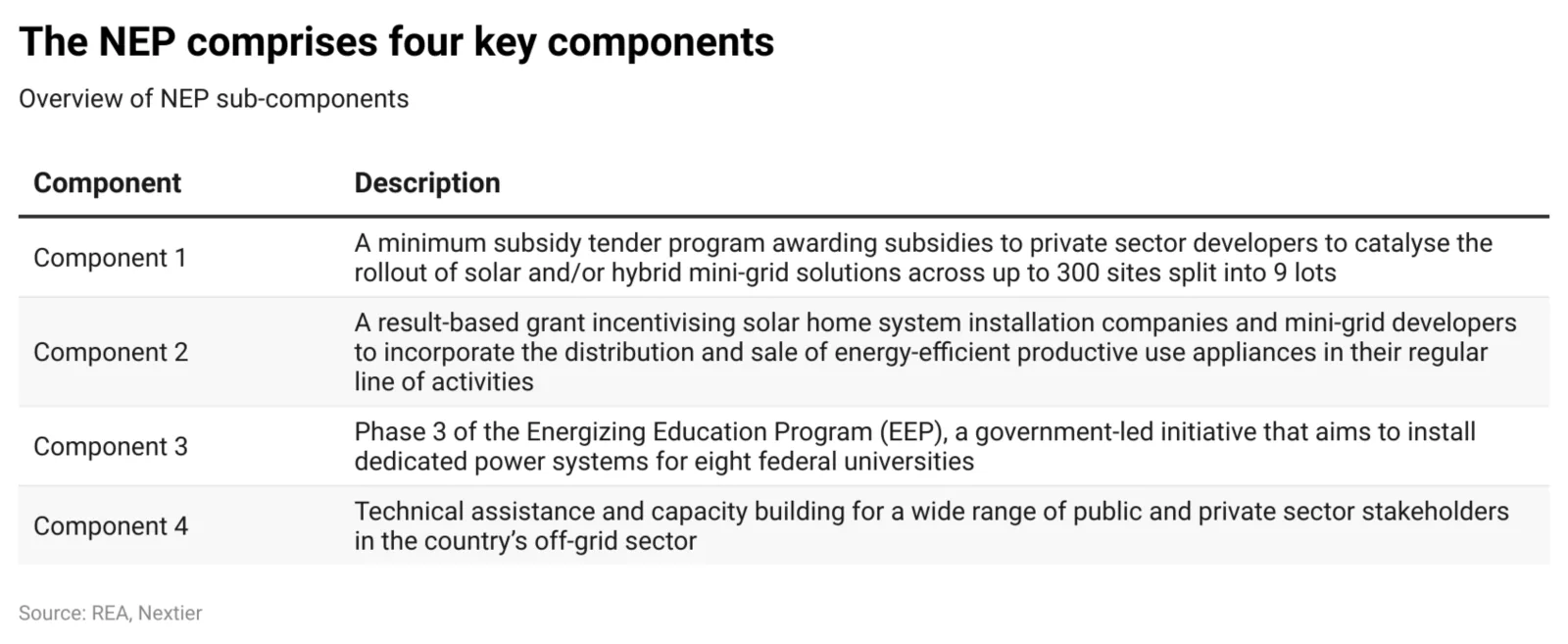
All four components are currently ongoing and according to the REA, 3.8 million people have electricity because of the NEP. This and other categories are visualised in the chart below, displaying the program’s projected and achieved impact.
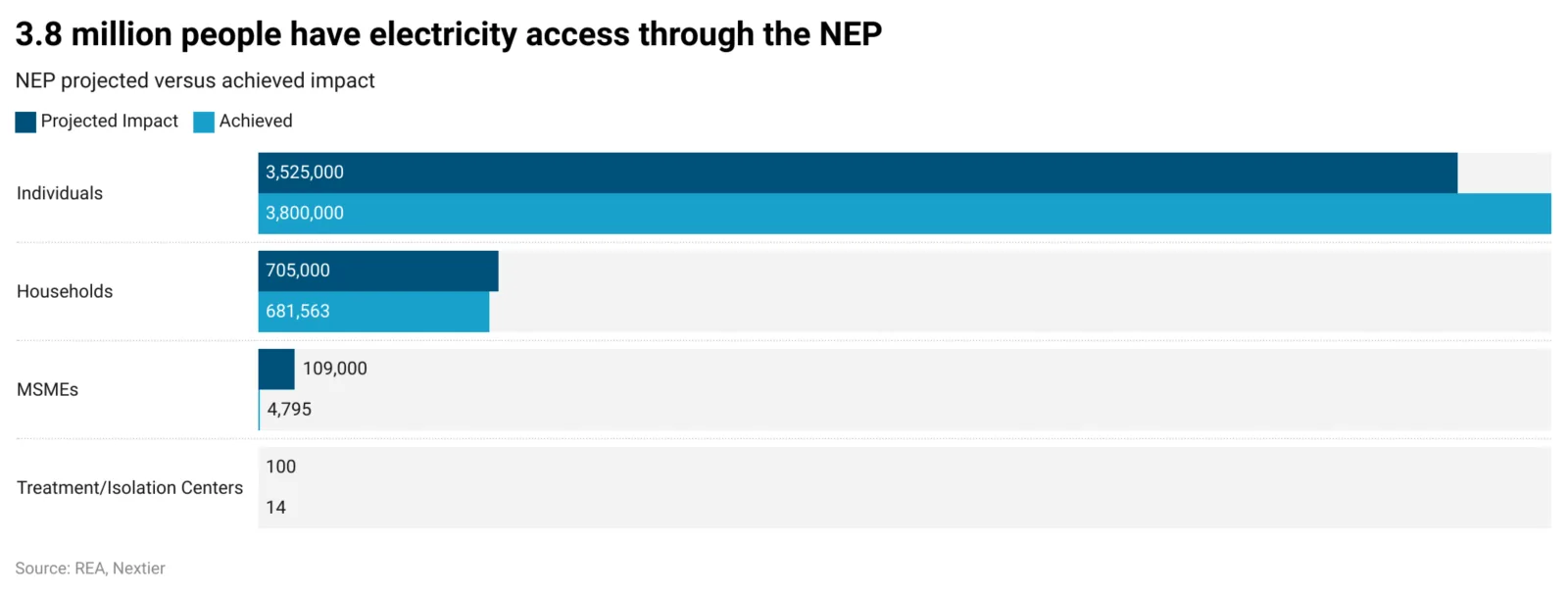
A major success of the program is reflected in the growing number of individuals and households gaining electricity access. However, underperformance among MSMEs is largely due to a mismatch between deployed Productive Use Equipment (PUEs) and the specific needs of local business owners, resulting in limited relevance to their trades.
The observed impact on treatment and isolation centers has also been considerably lower than initially projected due to the need for further assessment of the pre-selected centers, as many were found to be underutilised. Additionally, the electrification contracts were finalised post-pandemic lockdown, increasing projected costs from suppliers. Following the center assessments and further review of the agreements, outstanding treatment centers have now been commissioned for electrification.
Recently, the REA engaged Independent Verification Agents (IVAs) to review and verify the projects deployed by qualified implementing companies over the years. This process required result verification through field inspections and remote communication with the program beneficiaries. The verification process is crucial as it provides a means of monitoring project activity outputs and measuring success. It ensures that all reporting done by the implementing companies is accurate and that funds disbursed based on results accurately reflect the reality in electrified communities.
Nextier went through a competitive bidding process and emerged as the preferred consultant to serve as one of the independent verification agents (IVAs) for Southern Nigeria under Components 1 and 2.
This edition of Current, Nextier’s energy insights newsletter, presents some of the firm’s verification findings and recommendations for improved success under the NEP.
Our findings
Component 1 of the project involves the distribution of solar hybrid mini grids for economic development in rural communities with high economic growth potential by companies qualified by the REA. The implementation of this component is done via four sub-components which include:
1. Minimum subsidy tenders provided to energy access companies (EACs) from the WB facility with preselected states and communities for implementation
2. Minimum subsidy tenders provided to EACs from the AfDB facility with preselected states and communities for implementation
3. Grants to support the development of pre-planned projects with a community identification and survey process done by mini-grid developers and weighed by prior performances
4. A COVID-19 & beyond initiative to provide power to isolation and treatment centers (ITCs) to curb the spread of the virus, which has now been concluded
Component 2 involves a financing process for deploying PUEs to micro, small, and medium-sized enterprises (MSMEs) and households. Funds will be disbursed to Energy Access Companies (EAC) based on the results of the deployment i.e. number of equipment distributed, reported, and verified.
Both components require the development of solar hybrid mini-grids and productive use equipment (PUEs) for rural communities by EACs verified by the Agency at a subsidised price. After project delivery, the difference between the actual cost of the equipment and sale price to beneficiaries will be paid to the EACs by the REA.
For Component 1, Nextier verified customer connections and confirmed satisfactory electricity service. On the other hand, Component 2 involved authenticating the validity and correctness of reported PUEs supplied to ensure that they were metered and in use.
We conducted a phone survey and field verification but encountered issues at different stages of verification, centered mainly on validation processes, product inefficiency and reporting discrepancies.
1. Ineffective validation processes:
Nextier experienced difficulties in reaching beneficiaries, on the field and remotely, who reportedly received products from qualified EACs. Poor cellular service and field agents’ inability to locate recorded communities resulted in accessibility issues. These issues affected the IVA validation process, consequently affecting the final phase of the data verification exercises aimed at ensuring payment alignments between the beneficiaries, the EACs and the REA.
2. Product inefficiency:
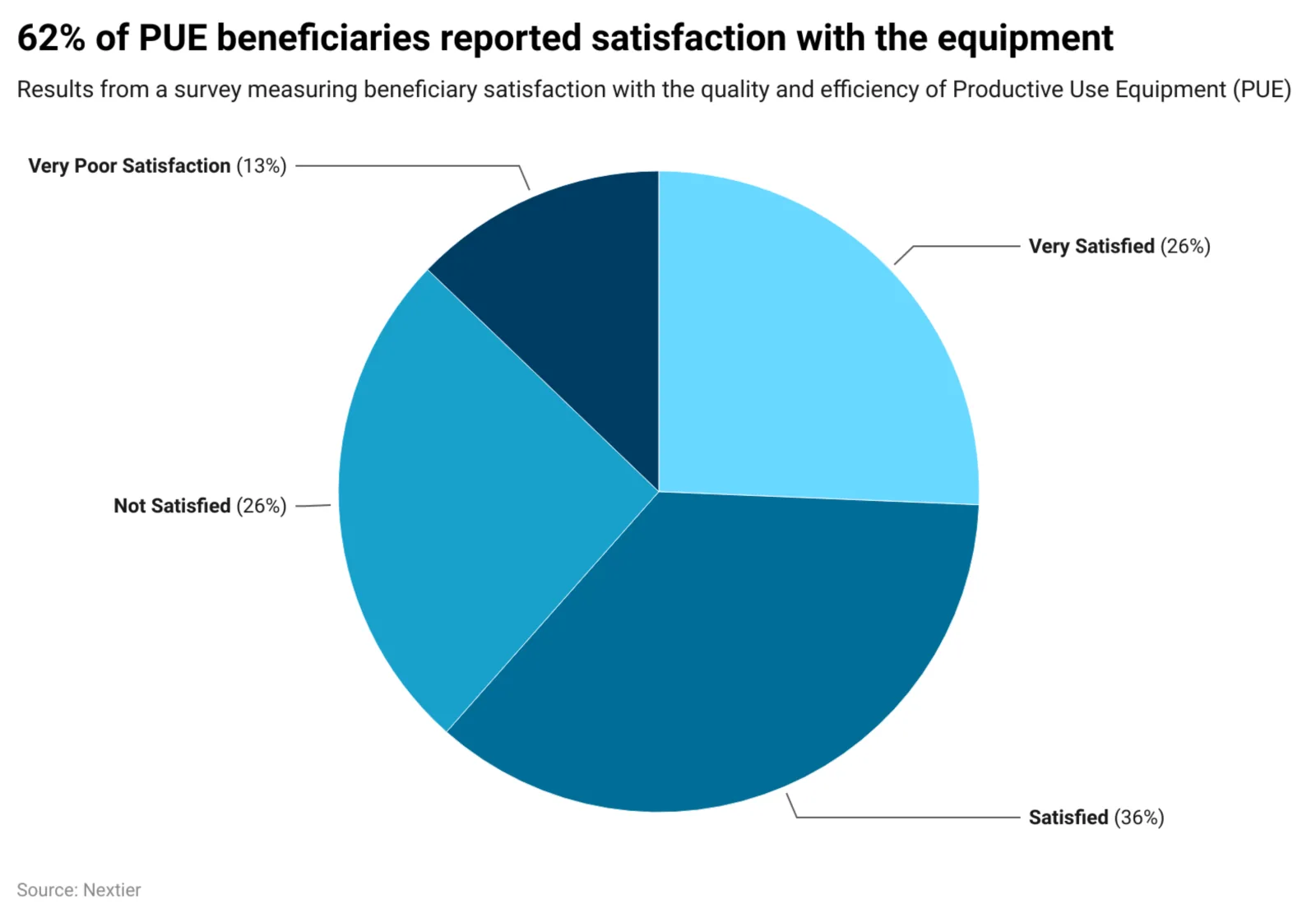
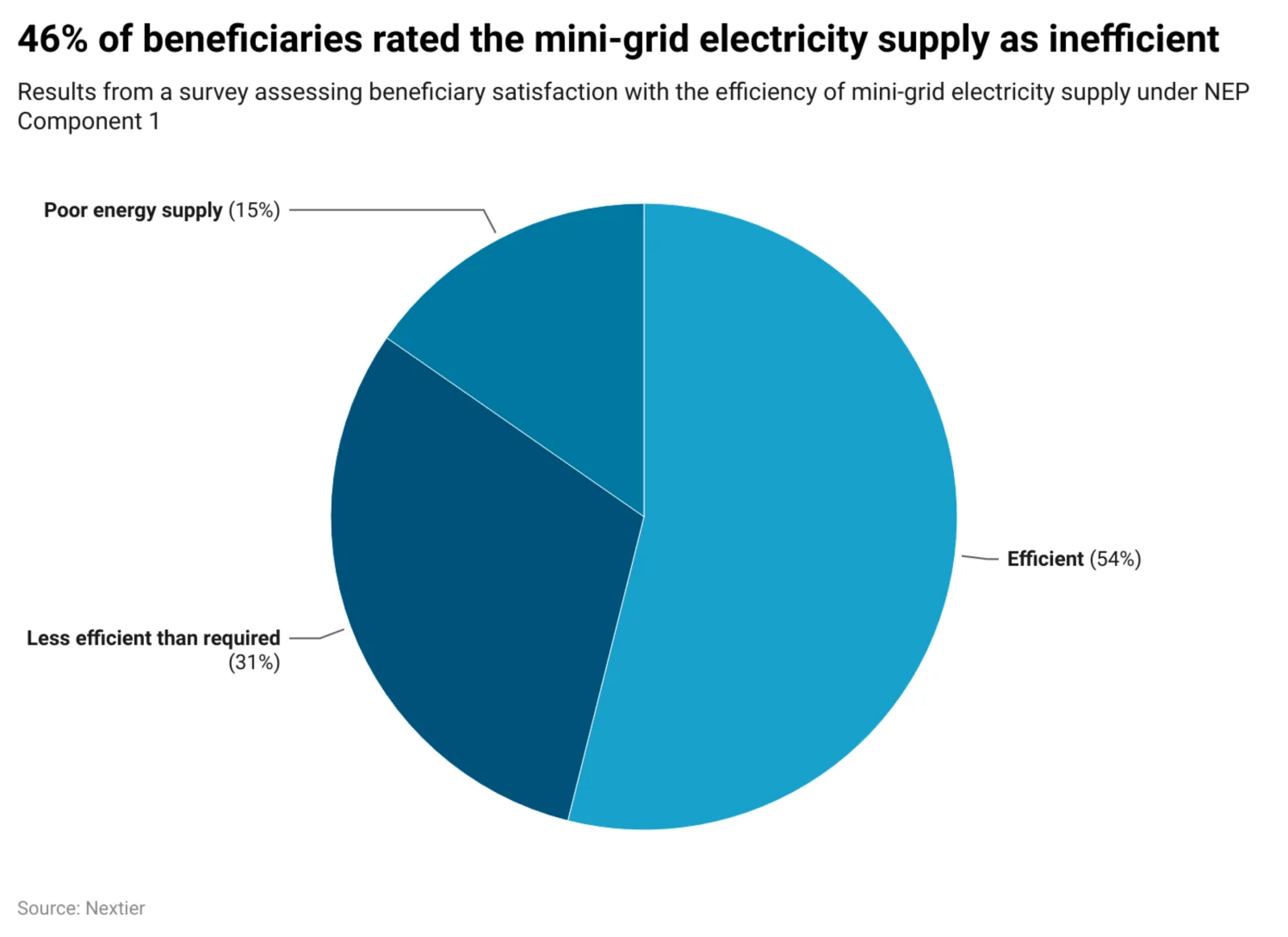
Despite the challenges posed by ineffective validation processes, feedback received on the quality and suitability of mini-grid systems and PUEs was somewhat satisfactory. Some beneficiaries reported substandard equipment with below-average performance. Just 26% of the customers reported being very satisfied with the quality of appliances provided (mostly water pumps and refrigerators), and 54% stated that the electricity supplied was efficient for running businesses. Further, the equipment was deployed without a warranty and did not perform very well or last long with beneficiaries.
3. Reporting discrepancy:
Nextier also observed discrepancies with the information submitted by EACs against information confirmed. These discrepancies, however minute or material, threaten the integrity of the program and the implementation agency. Discrepancies touched on the description and nature of equipment reported to be distributed by EACs and those confirmed to have been given to beneficiaries. Although occurrences were minimal, the resulting effects may pose larger issues to the practical implementation of the program. These discrepancies speak to larger output issues on payments and affect feedback and data within the sector, especially data concerning the underutilisation of PUEs.
The NEP has undoubtedly made significant strides in achieving its objectives and electrifying an identified portion of the rural communities. However, these issues must be rectified to ensure continued success.
Recommendations for bridging the gap
Our recommendations on the NEP mostly centered around strict and systemic monitoring at different points of implementation.
In confirming the validity of the work done by EACs, the REA may consider deploying independent field agents to identified communities or embedded within EACs to confirm the status of infrastructure and equipment.
However, developing standardised reporting templates and platforms easily accessible to EACs will aid the validation process while ensuring structure. Also, making subsidy payments in tranches upon completing and establishing milestones and deliverables, while engaging IVAs at the final stages will also guarantee impact delivery.
The processes developed should involve detailed reporting and documentation systems, subject to the confirmation of embedded or deployed agents within specific EACs and communities. Working with network providers to establish cellular service in remote areas and facilitating remote validation for second-final stage confirmation will also improve the process. Remote sensing and tracking technologies for implementation and EAC qualification will also aid in consistently and widely monitoring mini-grids and PUEs deployed.
Still on the subject of monitoring, the program’s efforts will be futile when mini-grid infrastructure developed in communities does not perform at maximum capacity and appliances provided continue to malfunction.
The REA must advance beyond qualifying EACs and develop authorisation processes that inspect infrastructure and appliances intended for deployment. Procedures validating equipment at the Agency, further confirmed by site and embedded agents upon delivery will reduce the installation of faulty appliances and infrastructure below standard. Such processes will also validate records of the nature and description of appliances as well as mini-grid structures said to be deployed to households, and MSMEs within communities. To facilitate continued monitoring and evaluation processes, logbooks of equipment deployed by EACs in communities should be kept, aiding periodic inspections and reviews remotely and onsite.
Beyond pacing payments through milestones and deliverables achieved by EACs, efficient disbursements require thorough monitoring procedures complemented with automated and digitised systems. The REA may also employ self-validation processes by MSMEs and households within communities in partnership with local governments and community leaders to aid implementation.
This procedure for confirming mini-grid installation and PUE distribution will be revalidated through field agents embedded in communities. These agents will also make records of purchases after inspecting infrastructure installed and appliances bought by individuals to reduce discrepancies in receipts recorded and monetary claims made by EACs.
Alternatively, engaging microcredit or microfinance institutions within communities to aid targeted subsidy disbursement will likely improve the financial roll-out process, minimising the financial discrepancies. The expected book-keeping, recording and documentation procedures required within the financial sector will facilitate the due diligence process and enhance tracking of fund utilisation.
Achieving efficiency under the NEP
Ultimately, increased presence leads to improved outcomes, addressing significant challenges and minor issues currently faced in program implementation. More presence means better results.
By fostering relationships and engaging directly with intended beneficiaries through effective relationship management and training, we can stimulate interest and encourage active participation in the program’s implementation. When beneficiaries have clear contact points with the implementing team, they are more likely to collaborate effectively with direct access for complaints when they encounter difficulties with products deployed, particularly PUEs.
This approach not only mitigates potential misconduct by EACs but also enhances reporting processes and progress tracking. The REA must strengthen its presence within beneficiary communities to achieve maximum product utilisation, efficiency and overall project impact.
Written by Elohozino Okpowo & Folake Aletan
More from Power
All publications · 20
Nigeria Power Sector Intelligence Report — Q1 2026
This edition introduces the Nextier Nigeria Power Sector Market Index (N-PSMI), a quarterly composite score that measures the health of NESI across four dimensions: generation, transmission, commercial viability, and…
PDF
Nigeria’s Mini-Grid Regulations: What Has Changed, What Has Stayed, and Where the Sector is Heading
As Nigeria seeks to connect millions of underserved households, the 2026 Mini-Grid Regulations introduce the clearest signal yet that the sector is entering a new phase of maturity. Larger project…
PDF

Nigeria Cold Storage Sector: Investment Analysis & Market Opportunity
Nigeria doesn’t have a food production problem as much as it has a preservation problem. While millions of tonnes of food are harvested each year, a significant share never reaches…
PDF