
Power · Analysis
Cutting the Cord on Federal Electricity Subsidies

Weaning Nigeria’s Electricity Supply Industry from Subsidies
The Nigerian government subsidises the power sector by capping the tariff distribution companies can charge for electricity. This difference between the cost-reflective tariff, which is needed to meet the utilities’ revenue requirement, and the allowed capped tariff is the tariff shortfall.[1]
In 2023, the tariff shortfall cost the Federal Government ₦650 billion ($677 million), a 116% increase from ₦313 billion ($144 million) in the previous year. This significant increase was driven by worsening macroeconomic conditions in the country. The naira depreciation and rising inflation resulted in higher energy supply costs with no commensurate increase in allowed tariff.
Affordability is a key challenge for Nigeria’s electricity consumers due to low disposable incomes, with inflation at 32.7% in September 2024. This isn’t surprising given the high cost of living, relatively low incomes, and high rate of underemployment.
However, the opportunity cost of subsidies to the Nigerian economy is immense. Beyond the financial cost to the government, subsidies reduce the incentive for efficiency among electricity market players. The exponential growth of this payment over the years makes it difficult for the government to fund or even justify the expense, considering the country’s ₦9.18 trillion ($6.4 billion) 2024 budget deficit.1
To reduce the tariff shortfall, the Nigerian government and the World Bank in 2020 commenced efforts to reform the power sector through the Power Sector Recovery Programme (PSRP). One of the programme’s objectives is the gradual transition of the market to cost-reflective tariffs, or one without tariff shortfalls. To achieve this goal, the sector regulator, Nigerian Electricity Regulatory Commission (NERC) introduced the Service-Based Tariffs (SBT).
This tariff regime, which links service quality, particularly the hours of supply received, to the cost of electricity, reduced the shortfall to ₦144.3bn ($341m) in 2022, a 266% decline from 2019.
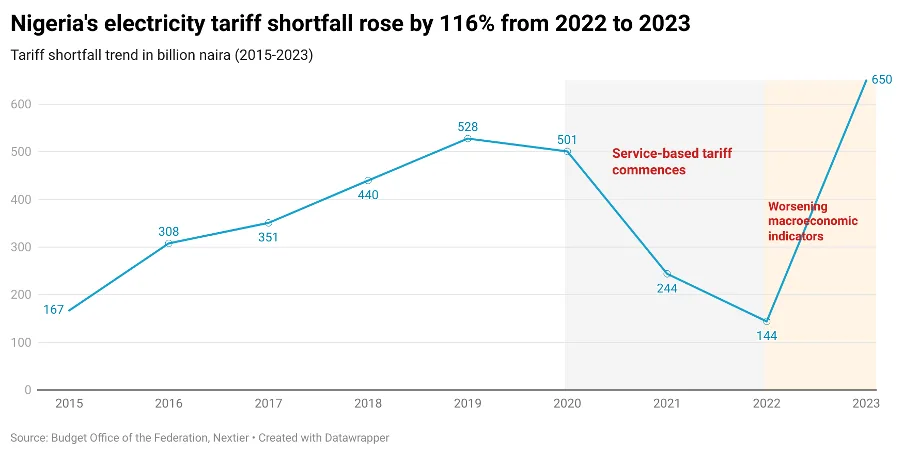
In 2023, however, the shortfall ballooned to ₦650.4bn ($1.02bn) due to an increase in the unit cost of electricity which is driven by changes in the country’s macroeconomic conditions, particularly the naira-dollar exchange rate and the inflation rate. Both of which underpin wholesale generation and retail electricity supply costs, key drivers of tariff rates.[2]
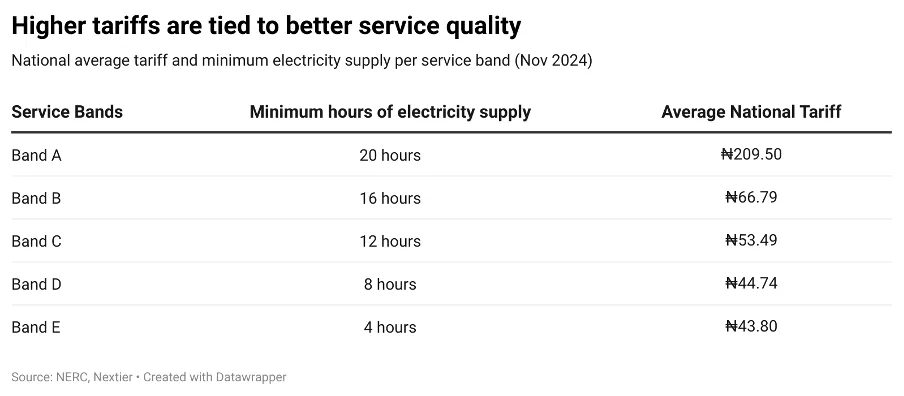
By increasing the allowed tariff for Band A customers in April 2024, NERC aims to reduce the tariff shortfall by ensuring that subsidy payments mainly cover energy supply to consumers receiving a lower quality of service. Band A customers—consumers receiving a minimum of 20 hours of daily supply—now effectively pay a cost-reflective tariff of ₦209.50/kWh.
This article presents strategic recommendations for the Nigerian government to gradually reduce—and eventually eliminate—the electricity subsidy, paving the way for a more sustainable energy sector.
How Nigeria’s cost-reflective electricity tariffs are determined
NERC, through a Multi-Year Tariff Order (MYTO), computes the tariff for electricity consumers. The MYTO allows electricity producers to sell electricity at a rate that ensures a fair return on their investments while allocating industry risk efficiently.
The methodology allows bi-annual minor reviews and major reviews every five years. These reviews ensure that the final end-user tariff is updated to account for changes to the country’s macroeconomic factors such as inflation and foreign exchange rates, as well as improvements in sector efficiency and capacity. The recent macroeconomic changes in the country have necessitated significant upward reviews to the end-user tariffs in 2024.
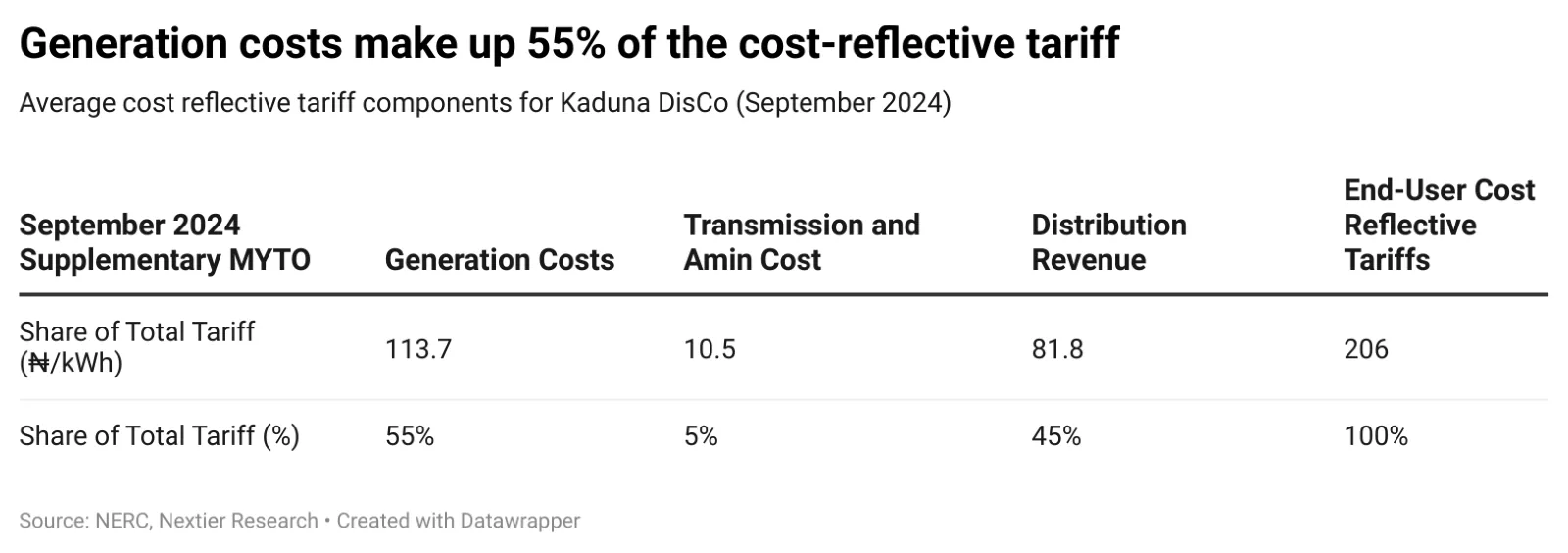
The retail tariff comprises four cost components: generation, transmission (including the system operations and market operations cost), distribution, and other ancillary services. Generation costs make up the bulk of the tariff, as such, increases in the generation cost inputs tend to have a significant impact on the end-user tariff.2
In the first half of 2024, thermal (mainly gas-powered) power plants provided 73% of the average available capacity. Generation costs in these plants are reliant on natural gas prices, which are US dollars. Therefore, significant macroeconomic changes, such as a steep naira depreciation, will incur higher generation costs, which the regulator passed on to the end-users. Significant changes in the inflation rate in both the US and Nigeria also impact the final generation costs, as they are key factors that affect a generation company’s ability to obtain returns on their investment.
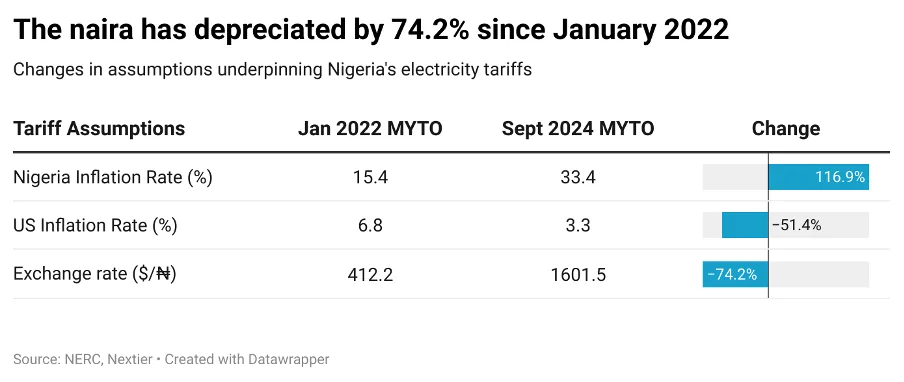
The recent negative changes in Nigeria’s macroeconomic outlook have had an impact on wholesale generation prices. For instance, in 2022 MYTO for the Abuja Electricity Distribution Company (AEDC), the generation cost component made up about 50% (₦27.5/kWh) of the total cost-reflective tariff. By September 2024, the generation cost share rose to 58% (₦113.69/kWh).
This increase was due to changes in tariff assumptions between 2022 and 2024 including the inflation rate which increased from 15.4% to 33.4% and the naira’s 74.2% depreciation against the dollar.
Power supply efficiency is another factor that affects the end-user tariff. The MYTO methodology is designed to incentivise utilities to improve supply efficiency and reduce customers’ costs. Distribution companies (DisCos), however, have not been able to do this. While the subsidy’s existence reduces the incentive for efficiency among the DisCos, the resultant lack of capital has made them unable to achieve their loss targets over the years.
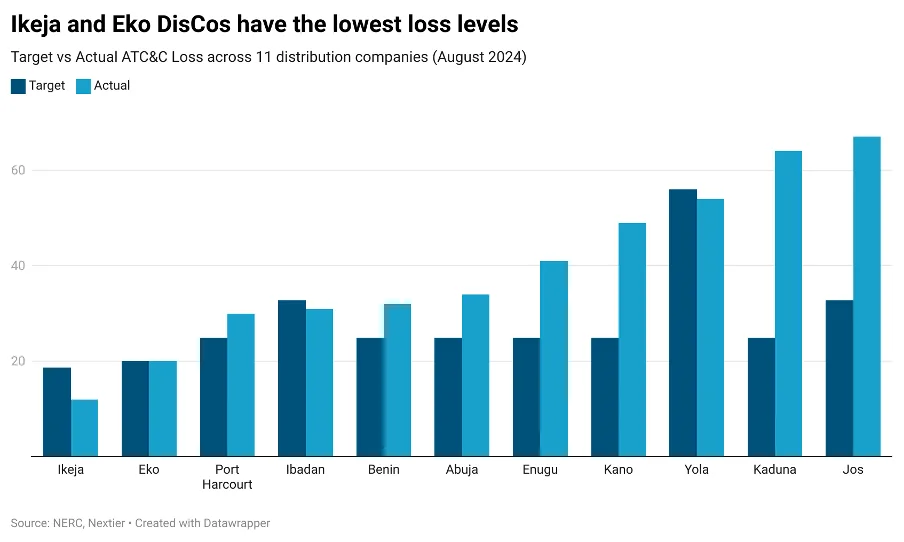
In 2023, AEDC estimated that it will require an investment of ₦9.86 billion ($15.4 million) to reduce losses by 1%. This value will be higher in 2024 due to the naira’s depreciation. For context, Abuja DisCo’s (AEDC) loss level was 34% in August 2024 while their 2024 target is 25%. Using the outdated 2023 investment numbers, achieving the 2024 loss target will require ₦88.74 billion ($53.7 million).
Without sufficient capital injections, DisCo loss targets have remained below the targets, resulting in higher tariffs for customers. For instance, losses in one of the DisCos studied by Nextier contributed 25% to the average tariff, the second largest component after the generation cost. If the DisCo’s losses were at target levels, the average tariff would have decreased by ₦15.12/kWh.
Nextier’s recommendations seek to achieve two objectives—reducing the electricity subsidy while ensuring tariffs are affordable for Nigerians. This requires improving the efficiency of Nigeria’s electricity market and even the subsidy’s efficiency.
Nextier’s Recommendations
Our recommendations suggest ways to improve liquidity in the wholesale electricity market through the connection of large industrial customers. We also believe that improving distribution efficiency will reduce the cost of supply for consumers with affordability constraints. We also suggest that the federal government employ a better mechanism for targeting subsidy payments to electricity consumers who need them the most.
1. Leverage industrial customers
Unlike households and small businesses, large industrial customers do not have an affordability constraint. These consumers typically utilise over 25,000kWh of electricity annually for economic activities. This class of users usually form the anchor consumers that justify the bulk supply that helps to lower the per unit cost of power for all consumers. However, these consumers require supply reliability to ensure efficiency in their operations, something that the Nigerian grid cannot currently provide. As a result, industrial consumers mainly depend on self-generation to meet their electricity supply needs.
There is potential to leverage the benefits that large energy consumers can provide to the electricity market. Bilateral energy supply agreements between generation companies and large industrial energy consumers or industrial clusters can help mitigate volume risks for the generation companies and lower their marginal electricity generation costs.3
This idea is not new as the regulator has enacted regulations to help achieve this. The recently amended Eligible Customers Regulations 2024 (the first version was implemented in 2017) aimed to facilitate power supply through bilateral agreements between large industrial consumers and the generation companies. However, getting industrial consumers to sign these agreements with generation companies has proven elusive.
One reason for this has been the high consumption threshold required to qualify as an eligible consumer (EC). Under the first EC Regulations, prospective eligible consumers had to consume 2MWh/h (over 90 days). That figure was increased to 6MWh/h. Another challenge is the definition of an “eligible customer” as a single end-user. This means that two medium-sized industrial consumers cannot merge to identify as an “eligible customer”.
Across Nigerian cities, there are commercial centres where medium-sized businesses could coalesce into large demand consumers. These large consumers can directly purchase power from generation companies, injecting much needed liquidity into the wholesale generation market.
But there is currently no framework for recognising a group of industrial consumers (or an industrial clusters) as a potential end-user that can qualify as an EC. The regulator needs to develop a framework to facilitate the connection of pools of industrial and commercial clusters as eligible consumers. This would require making significant allowances for industrial consumers to collaborate and meet the consumption threshold and the other market requirements.
2. Enhance distribution efficiency
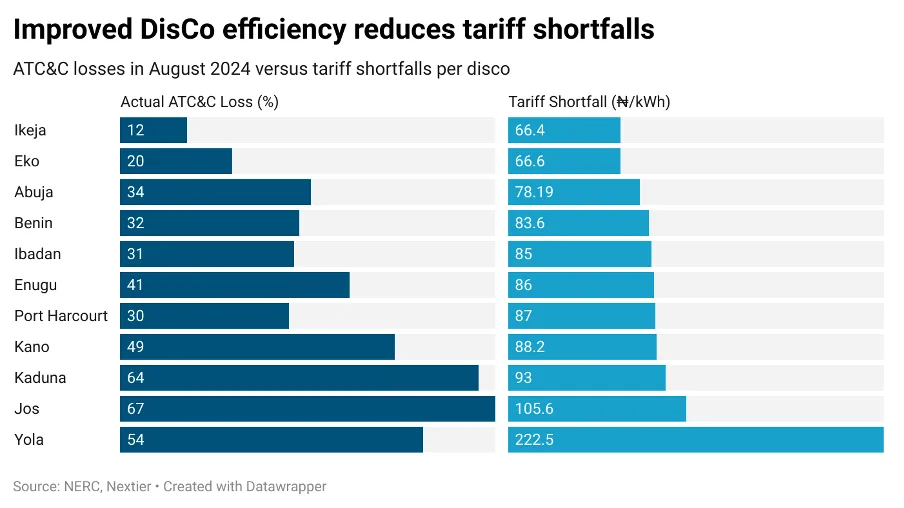
Enhancing distribution efficiency by minimising Aggregate Technical, Commercial and Collection (ATC&C) losses would significantly reduce DisCos’ revenue requirement and the end-user tariff.
However, DisCos currently cannot finance the infrastructure needed to strengthen their networks and reduce losses. Often, government investments in transmission and distribution networks do not align with DisCos performance improvement plans. The government needs to work with distribution companies to target investments in areas that support DisCos loss reduction.
3. Targeted subsidy
The service-based tariff (SBT) has been effective in reducing the tariff shortfall, as it increases the number of consumers who pay the full cost of their power supply, while ensuring that the government does not subsidise customers who can afford their electricity bills. By disaggregating consumers into Bands based on their service level, the SBT incentivises the DisCos to improve the efficiency of their supply, network infrastructure and collections to continually expand their higher paying consumer base.
However, the government still needs to improve its mechanism for targeting subsidies. Adopting a means-testing mechanism for assessing households’ energy affordability would improve the effectiveness of payments. Such a mechanism should assess a household’s eligibility for energy credit units and how much they are entitled to.
This assessment could be based on factors such as household income, savings, and other social welfare benefits they currently receive and would result in significant fiscal savings for the government. Means-testing has been shown as a more effective way of providing subsidy payments. The UK government recently adopted means testing as a way to reduce the number of people who receive its Winter Fuel Payment in England and Wales.
While the current tariff regime has a lifeline class, the lack of adequate data and consumer metering means that it is quite difficult to establish the consumers that qualify for this class and to what extent they should be subsidised.4 As the average energy demand increases, it will also be difficult to adjust the minimum energy needs of this class.
Implementing a means-testing mechanism would require significant synchronisation of several social welfare databases. It would also help the government to formulate, implement and monitor the progress of policies to eliminate energy poverty.
A fully liberalised electricity market will not ultimately eliminate energy access challenges
To achieve its universal energy access target, the government must exert some influence, particularly when its citizens face affordability issues. In this situation, the government should focus on providing direct support to citizens instead of intervening in the market. The priority should be on improving liquidity in the wholesale electricity generation market, enhancing distribution efficiency and ensuring that any subsidy payments are targeted.
Beyond the power sector, improving the earning potential of Nigerians to solve the affordability issue is critical. By increasing capital investments in education, healthcare and other critical sectors, as well as ensuring an improvement in macroeconomic indicators such as inflation and the exchange rate, more Nigerians will be able to afford electricity payments, reducing the need for a subsidy.
Written by Uche Okoro & Olayemi Aworolo
[1] This is the total amount of money that a utility needs to collect from customers to cover all of its business costs, including a reasonable return on and of investment. It is essentially the cost of generating and supplying power.
[2] Average annual exchange rates for 2015 (₦198:$1); 2019 (₦358.39:$1); 2022 (₦422.75:$1); 2023 (₦634.22:$1)
More from Power
All publications · 20
Nigeria Power Sector Intelligence Report — Q1 2026
This edition introduces the Nextier Nigeria Power Sector Market Index (N-PSMI), a quarterly composite score that measures the health of NESI across four dimensions: generation, transmission, commercial viability, and…
PDF
Nigeria’s Mini-Grid Regulations: What Has Changed, What Has Stayed, and Where the Sector is Heading
As Nigeria seeks to connect millions of underserved households, the 2026 Mini-Grid Regulations introduce the clearest signal yet that the sector is entering a new phase of maturity. Larger project…
PDF
Nigeria Cold Storage Sector: Investment Analysis & Market Opportunity
Nigeria doesn’t have a food production problem as much as it has a preservation problem. While millions of tonnes of food are harvested each year, a significant share never reaches…
PDF