
Security, Peace & Development · Bi-Monthly Report
Nigeria Violent Conflict Bi-Monthly Report
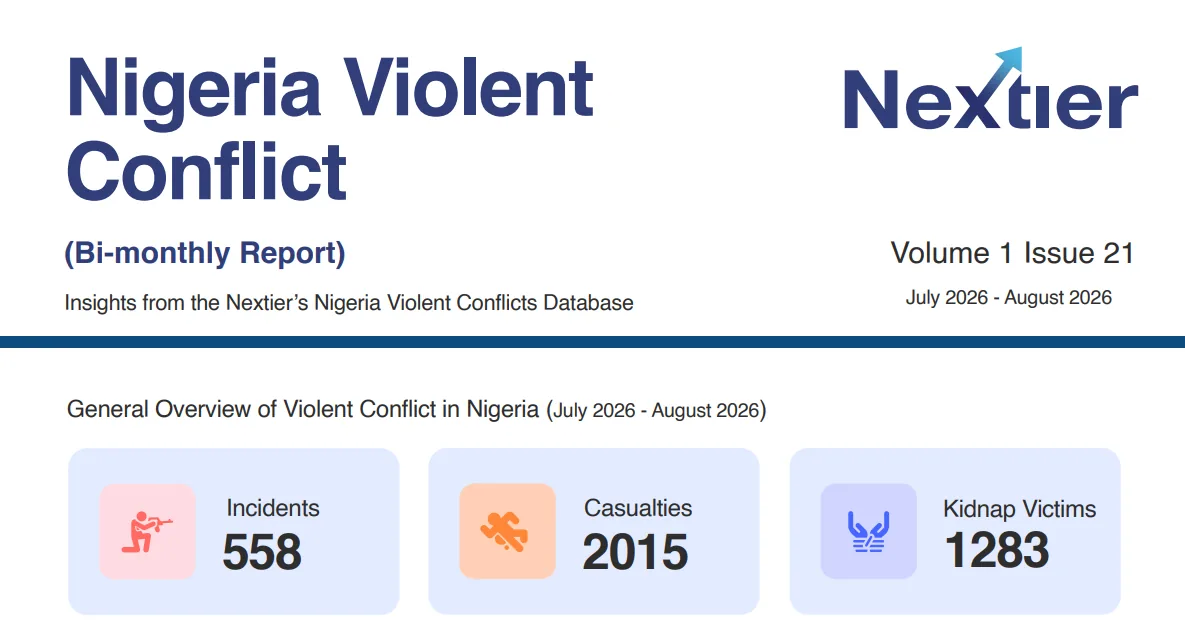
The July–August 2026 reporting period unfolded amid intensifying political activity and a security environment marked by multiple violent conflicts. On July 9, 2026, President Bola Tinubu convened security chiefs in Abuja to review the security threats. By late July, he echoed that both the economy and the security situation were improving, thanks to closer coordination among the military, police and intelligence services. The most visible vindication of that narrative came when security forces secured the release of students and teachers abducted in May from Oriire LGA, Oyo State. The Defence Headquarters described the operation as one of the largest hostage-rescue operations in Nigeria’s history.
That success was set against a challenging two months. On August 21, 2026, a coordinated attack on four mosques during Friday prayers in Borgu LGA, Niger State, left dozens of worshippers dead and many abducted. Media outlets reported varying abduction figures, underscoring ongoing challenges, as source discrepancies continue to complicate real-time casualty accounting in Nigeria’s conflict-affected communities.
Politically, Nigeria’s off-cycle election calendar advanced further with the Osun State governorship election on August 15, 2026, in which incumbent Governor Ademola Adeleke of the Accord Party was returned for a second term, despite reports of electoral violence. President Tinubu also used the period to publicly link Nigeria’s insecurity to instability in the neighbouring Sahel. On July 30, he stated that the deteriorating security situation in Mali, Burkina Faso and Niger was adding to Nigeria’s internal security challenges, a view rejected by the AES governments.
The period also unfolded against a fraught regional and global security landscape. In the Sahel, Mali’s transitional parliament voted on 3–4 July to grant Colonel Assimi Goïta a renewable five-year presidential term, further postponing any return to civilian rule, even as JNIM expanded its operations across central and northern Mali and imposed blockades on routes leading to Bamako. In neighbouring Niger, JNIM and the Islamic State Sahel Province intensified competing attacks, making the country’s west a central battleground. Globally, the period was dominated by an escalating confrontation between the United States and Iran, including renewed strikes and Iranian-linked Houthi attacks on Gulf shipping and oil infrastructure that briefly unsettled energy markets, a reminder of how instability well beyond Nigeria’s borders continues to intersect with the domestic pressures shaping the conflict landscape reviewed in the July-August report.
Domestically, banditry, kidnapping and cult clashes continue to dominate the violent-conflict landscape, alongside a persistent undertow of gunmen attacks and terrorism. In the period under review, banditry recorded 201 incidents and 984 casualties, kidnapping accounted for 106 incidents and 430 kidnap victims, and cult clashes were overwhelmingly concentrated in Lagos and the wider South West, with 60 incidents and 111 casualties. Gunmen attacks (54 incidents, 228 casualties) and terrorism (52 incidents, 374 casualties, 111 kidnap victims) rounded out a period in which every major conflict category in the Nextier’s Nigeria Violent Conflicts Database recorded activity in at least four of Nigeria’s six geopolitical zones.
Click here to doanload report
More from SPD
All publications · 20
Nigeria Security and Safety Perception Wave 2 Survey Report
The second wave of the Nigeria Security and Safety Perception Survey (NSSPS), conducted in July 2026, captures how citizens across all 109 senatorial districts perceive safety, security threats, institutional trust,…
PDF

The Policing Conversation: Security Imperative or Fiscal Time Bomb for State Governments
As Nigeria moves closer to establishing State Police, the debate is increasingly shifting from whether it is necessary to whether state governments have the fiscal capacity to establish, operate, and…
PDF
Leveraging Existing Community Security Structures Through A People-Centered Public Safety Lens: Lessons from Bayelsa State
Public safety cannot be achieved through policing alone. It requires communities to have the capacity, trust, and structures to play an active role in identifying and preventing threats while working…
PDF